
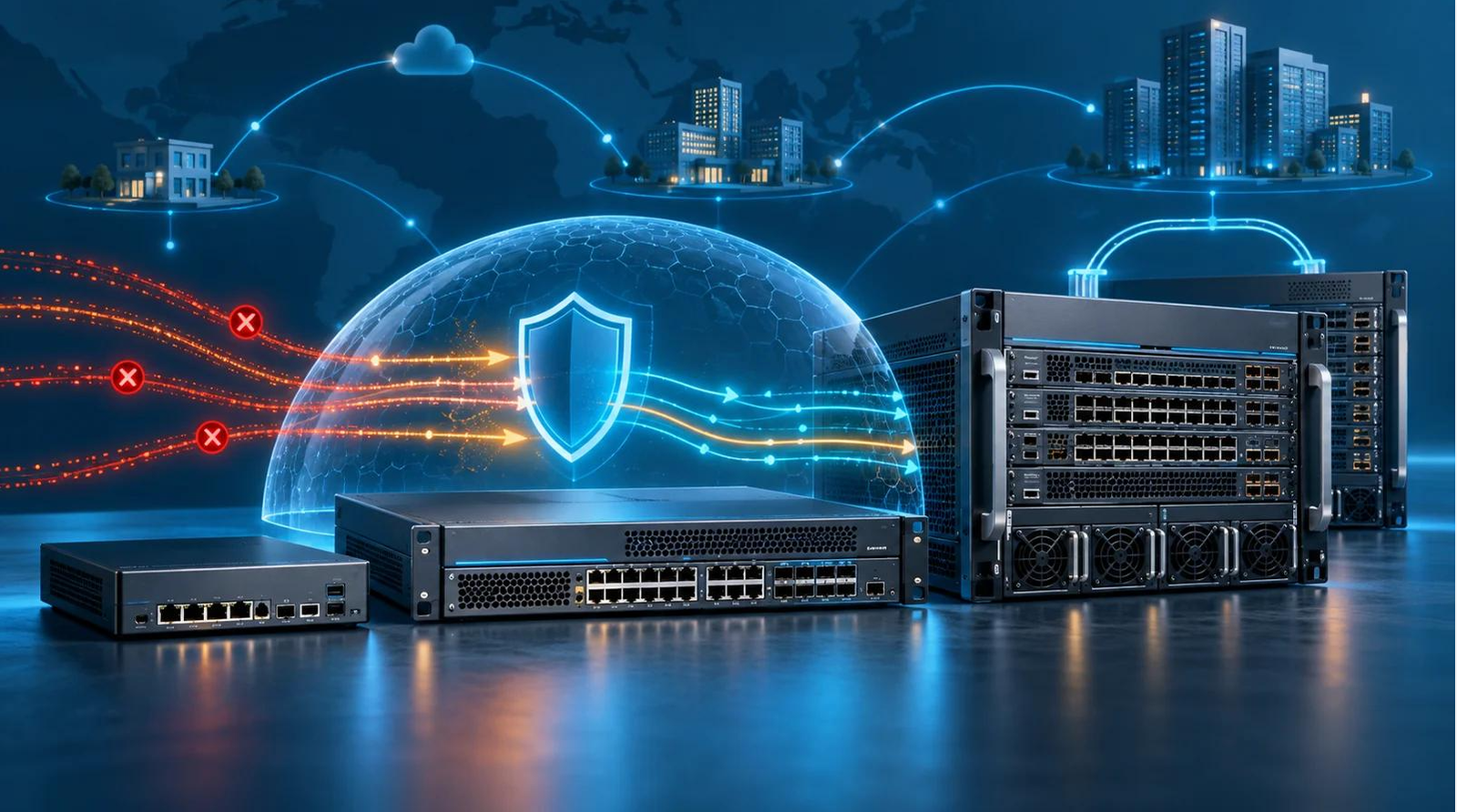
Innovative solutions for security
Fortinet vs. Palo Alto: Enterprise Firewall Considerations Compare Fortinet FortiGate and Palo Alto Networks next-generation firewalls for enterprise security. Explore application control, threat prevention, SSL/TLS inspection, SD-WAN, high availabilit
Fortinet vs. Palo Alto: Enterprise Firewall Considerations
Choosing the Right Next-Generation Firewall for Secure, Scalable, and Resilient Enterprise Networks
Enterprise cybersecurity has evolved beyond traditional port-based firewall filtering. Modern organizations require advanced threat prevention, application visibility, encrypted traffic inspection, identity-aware access controls, secure branch connectivity, and centralized security operations.
Two prominent enterprise firewall platforms are Fortinet FortiGate and Palo Alto Networks Next-Generation Firewalls (NGFWs).
Both vendors provide advanced security technologies designed to protect enterprise campuses, data centers, branch networks, cloud infrastructure, and business-critical applications.
However, their product architectures, management ecosystems, security workflows, and deployment considerations differ.
At Pruthvija Technologies, we emphasize selecting security solutions based on business requirements, infrastructure compatibility, application performance, operational manageability, and long-term security objectives.
This article compares Fortinet and Palo Alto Networks firewalls and explains the important factors enterprises should evaluate before selecting an NGFW platform.
1. Understanding Next-Generation Firewalls
A Next-Generation Firewall extends traditional stateful firewall functionality with application identification, intrusion prevention, advanced security inspection, and additional threat detection capabilities.
Typical NGFW capabilities include:
-
Stateful traffic inspection
-
Application identification and control
-
Intrusion prevention systems
-
Antivirus and malware protection
-
URL and DNS filtering
-
SSL/TLS inspection
-
User and identity integration
-
VPN connectivity
-
Network segmentation
-
Centralized security policy management
-
Security logging and analytics
These capabilities help enterprises enforce security policies based on applications, users, content, and network context rather than relying exclusively on IP addresses and ports.
2. Fortinet FortiGate Overview
Fortinet FortiGate firewalls operate using the FortiOS operating system.
FortiGate integrates network security, routing, VPN connectivity, and SD-WAN functionality into a unified platform.
Core Fortinet Technologies
FortiOS: Firewall operating system providing networking and security capabilities.
FortiGuard Security Services: Security intelligence and subscription services supporting threat prevention, application control, web filtering, and related protections.
FortiManager: Centralized configuration management, policy administration, and orchestration.
FortiAnalyzer: Centralized logging, security analytics, reporting, and event analysis.
Fortinet Secure SD-WAN: Application-aware WAN connectivity and transport selection.
FortiGate HA: High-availability clustering for supported deployment architectures.
Common Enterprise Use Cases
-
Internet edge security
-
Branch office firewall deployment
-
Secure SD-WAN
-
Campus network segmentation
-
Data center perimeter security
-
IPsec VPN connectivity
-
Multi-site security management
-
Hybrid cloud network protection
FortiGate is often evaluated by organizations seeking to consolidate routing, SD-WAN, and network security capabilities.
3. Palo Alto Networks NGFW Overview
Palo Alto Networks next-generation firewalls operate using PAN-OS.
The platform emphasizes application-aware security policy enforcement, user identity integration, content inspection, and centralized security management.
Core Palo Alto Networks Technologies
App-ID: Identifies applications and supports application-based security policy enforcement.
User-ID: Associates users and groups with network activity for identity-aware policies.
Content-ID: Provides content inspection capabilities used by security services.
WildFire: Malware analysis and threat intelligence capabilities, subject to applicable subscriptions.
Panorama: Centralized firewall management, policy administration, and visibility.
Strata Cloud Manager: Cloud-based management for supported network security deployments.
GlobalProtect: Remote access and endpoint connectivity capabilities, depending on licensing and architecture.
Common Enterprise Use Cases
-
Data center perimeter security
-
Enterprise internet gateways
-
Application-aware segmentation
-
User-based security policies
-
Threat prevention
-
Secure remote access
-
Cloud security integration
-
Centralized security operations
Palo Alto Networks is frequently considered where detailed application identification, identity-aware policies, and integrated threat prevention workflows are important.
4. Application Control: Fortinet vs. Palo Alto
Application visibility helps security administrators understand which applications are communicating across the network.
Fortinet Application Control
FortiGate supports application identification and control through FortiOS security profiles.
Administrators can define policies to monitor, allow, block, or otherwise handle supported application categories and signatures.
Palo Alto App-ID
Palo Alto Networks uses App-ID to classify traffic and support application-specific security rules.
App-ID can help administrators build policies that are more specific than traditional port-based access controls.
Enterprise Design Considerations
Organizations should evaluate:
-
Application identification accuracy
-
Custom application requirements
-
Encrypted application visibility
-
Policy complexity
-
False-positive behavior
-
Logging and troubleshooting
-
Impact on application performance
Best practice: Test business-critical applications under realistic traffic conditions before enforcing restrictive application-based policies.
5. Threat Prevention and Intrusion Protection
Both platforms support intrusion prevention and threat detection.
Fortinet
Depending on subscriptions and configuration, FortiGate can provide:
-
Intrusion prevention
-
Antivirus inspection
-
Application control
-
Web filtering
-
DNS security
-
Malware protection
-
Security event logging
Palo Alto Networks
Depending on subscriptions and configuration, Palo Alto Networks can provide:
-
Vulnerability protection
-
Antivirus and anti-spyware inspection
-
Advanced Threat Prevention
-
URL filtering
-
DNS Security
-
WildFire malware analysis
-
File blocking and data filtering
Best Practice
Threat prevention should be assessed using representative application traffic, appropriate security profiles, and a documented testing methodology.
No firewall can guarantee prevention of every cyberattack.
6. SSL/TLS Inspection and Encrypted Traffic Security
A significant portion of enterprise traffic uses encrypted protocols.
SSL/TLS inspection can help security teams inspect supported encrypted sessions for threats and policy violations.
Both Fortinet and Palo Alto Networks support inspection and decryption capabilities, subject to platform limitations and configuration.
Important Considerations
-
Supported TLS versions and cipher suites
-
Certificate management
-
Endpoint trust requirements
-
Privacy and legal obligations
-
Application compatibility
-
Certificate-pinned applications
-
Hardware performance
-
Exemption policies
-
Logging and audit requirements
Performance Considerations
Enabling deep inspection can significantly change effective firewall throughput.
For example, a firewall rated for high raw forwarding throughput may support a lower inspected throughput when IPS, malware scanning, and TLS decryption are enabled simultaneously.
Best practice: Size the firewall using realistic inspected traffic requirements, not only the headline firewall throughput figure.
7. SD-WAN and Enterprise Branch Connectivity
WAN integration is an important architectural difference.
Fortinet Secure SD-WAN
FortiGate integrates SD-WAN functionality within FortiOS.
Common capabilities include:
-
Multiple WAN transport interfaces
-
Performance-based path selection
-
Application-aware steering
-
Link health monitoring
-
IPsec VPN overlays
-
Routing integration
-
Centralized policy administration
Palo Alto Networks WAN Options
Palo Alto Networks provides SD-WAN functionality through supported firewall-based and Prisma SD-WAN solutions.
Deployment architecture and management capabilities vary between product offerings.
Selection Guidance
FortiGate may be attractive where an organization wants to combine branch firewalling and SD-WAN within a common operational platform.
Palo Alto Networks should be evaluated against the required SD-WAN product architecture, application connectivity, security integrations, and management model.
Best practice: Assess WAN architecture and firewall security together, but evaluate the complete solution rather than assuming all capabilities are included in every license.
8. High Availability: Active-Passive and Active-Active
High availability is essential for enterprise firewalls protecting business-critical applications.
Both vendors support HA configurations on compatible platforms.
Active-Passive HA
One firewall handles production traffic while the peer remains available to assume the active role following a qualifying failure.
Important components include:
-
Heartbeat connectivity
-
Configuration synchronization
-
Session synchronization where supported
-
Link monitoring
-
Failover criteria
-
Interface and VLAN consistency
-
Routing and ARP behavior
Active-Active HA
Both firewalls may process traffic depending on the platform and supported architecture.
Active-active designs require additional attention to session handling, routing symmetry, traffic distribution, and operational complexity.
Critical HA Validation
A successful role transition does not automatically guarantee service continuity.
Administrators must validate:
-
Primary-to-secondary failover
-
Secondary-to-primary failback
-
Internet access
-
Internal application connectivity
-
NAT behavior
-
VPN connectivity
-
Routing adjacency recovery
-
Session continuity
-
Switch and LACP behavior
-
Upstream and downstream MAC/ARP convergence
Best practice: Test failover in both directions under an approved maintenance window and verify actual application services.
9. Centralized Firewall Management
Large enterprises often require consistent policies across multiple sites.
Fortinet Management
FortiManager supports centralized configuration and policy management.
FortiAnalyzer provides centralized logs, reporting, and analytics.
Palo Alto Networks Management
Panorama supports centralized firewall management, policy administration, and visibility.
Strata Cloud Manager offers cloud-based management for supported deployments.
Evaluation Criteria
-
Policy consistency
-
Multi-site administration
-
Role-based access
-
Configuration backup
-
Change approval workflows
-
API and automation support
-
Security event visibility
-
Log retention
-
Integration with SIEM platforms
Best practice: Define operational ownership and policy governance before deploying centralized management.
10. Firewall Performance and Sizing
Firewall selection must account for both present and future requirements.
Key Sizing Parameters
-
Firewall throughput
-
Threat protection throughput
-
TLS decryption performance
-
Concurrent sessions
-
New sessions per second
-
VPN throughput
-
Interface speed and quantity
-
High-availability requirements
-
Logging volume
-
Expected traffic growth
For example, a data center with high east-west traffic may have different requirements from a branch office with internet breakout and IPsec VPN connectivity.
A firewall should be evaluated under the actual mix of security services that will be enabled in production.
11. Network Integration and Routing
Both Fortinet and Palo Alto Networks can integrate with enterprise routing and switching infrastructure.
Typical requirements include:
-
Static routing
-
OSPF and BGP
-
VLAN subinterfaces
-
Virtual routing instances
-
LACP and aggregate interfaces
-
NAT
-
IPsec VPN
-
Security zones
-
Data center interconnection
-
Cloud connectivity
Multi-vendor designs may include Cisco, Huawei, Extreme Networks, or TP-Link switching infrastructure.
Common Integration Challenges
-
VLAN tagging mismatch
-
LACP inconsistency
-
Routing adjacency failure
-
Asymmetric traffic paths
-
NAT policy conflicts
-
Firewall zone mismatches
-
HA failover convergence
-
MTU problems
Best practice: Validate firewall integration against the actual core switch configuration, upstream connectivity, and application traffic paths.
12. Licensing and Total Cost of Ownership
Firewall acquisition costs represent only part of the overall investment.
Organizations should evaluate:
-
Hardware or virtual appliance costs
-
Security subscriptions
-
Centralized management licensing
-
Support and maintenance
-
VPN and remote access requirements
-
Logging and analytics services
-
High-availability hardware
-
Training and operational support
-
Software upgrades
-
Hardware lifecycle and replacement
A lower initial purchase price does not always produce a lower long-term cost.
Best practice: Compare complete three- to five-year costs using equivalent security functionality and support assumptions.
13. Which Firewall Should Your Enterprise Choose?
Consider Fortinet FortiGate When:
-
Integrated firewall and SD-WAN functionality is important.
-
The organization uses Fortinet networking and security products.
-
Branch connectivity and centralized management are priorities.
-
The architecture benefits from consolidated networking and security.
-
The selected model meets inspected throughput and security requirements.
Consider Palo Alto Networks When:
-
Application-based security policies are a primary requirement.
-
User-aware policy enforcement is central to the security architecture.
-
The organization requires detailed application and threat visibility.
-
Existing operations align with PAN-OS and Panorama.
-
The selected platform meets performance, licensing, and integration requirements.
Consider Either Platform When:
-
Enterprise NGFW protection is required.
-
Data center or campus segmentation is needed.
-
High-availability firewall deployment is required.
-
Cloud and branch security must be integrated.
-
Centralized security administration is important.
The final decision should be based on validated technical requirements, proof-of-concept testing, operational readiness, and total cost of ownership.
14. Recommended Firewall Deployment Methodology
Phase 1 — Assessment: Review existing infrastructure, security policies, applications, routing, and traffic patterns.
Phase 2 — Architecture: Develop the HLD and LLD, including firewall placement, HA design, interfaces, VLANs, routing, and segmentation.
Phase 3 — Security Policy Design: Define zones, application access, identity controls, threat inspection, and NAT requirements.
Phase 4 — Implementation: Deploy firewall appliances, management connectivity, HA, routing, and security policies.
Phase 5 — Integration: Connect the firewalls with enterprise core switches, WAN infrastructure, data centers, and cloud networks.
Phase 6 — Validation: Perform connectivity, security inspection, routing, VPN, HA failover, and application testing.
Phase 7 — Handover: Provide configuration backups, documentation, acceptance reports, and operational procedures.
15. How Pruthvija Technologies Can Help
At Pruthvija Technologies, our enterprise cybersecurity and network security services focus on secure architecture, infrastructure integration, and operational reliability.
Our service capabilities include:
-
Next-generation firewall architecture and consulting
-
Fortinet FortiGate design and deployment
-
Palo Alto Networks NGFW design and deployment
-
Firewall HA implementation
-
Security policy assessment and optimization
-
Application control and threat prevention configuration
-
SSL/TLS inspection planning
-
IPsec VPN and secure connectivity
-
Enterprise routing and switching integration
-
Firewall migration and modernization
-
Security logging and monitoring
-
Failover testing and performance validation
-
HLD, LLD, SOP, MOP, and technical handover
We focus on selecting and implementing security solutions aligned with business objectives, infrastructure requirements, and long-term operational needs.
Conclusion
Fortinet FortiGate and Palo Alto Networks are both established enterprise firewall platforms with extensive next-generation security capabilities.
Fortinet offers an integrated approach to networking, security, and SD-WAN, while Palo Alto Networks emphasizes application-aware policy enforcement, identity integration, and advanced threat prevention workflows.
Neither vendor is automatically the best choice for every enterprise.
The right firewall is the one that delivers the required security effectiveness, inspected performance, infrastructure compatibility, high availability, operational simplicity, and long-term value.
Pruthvija Technologies — Securing Networks. Protecting Enterprises. Enabling Digital Transformation.
Ready to Strengthen Your Enterprise Network Security?
Contact Pruthvija Technologies to discuss next-generation firewall architecture, Fortinet and Palo Alto deployment, security assessments, high availability, and enterprise network security modernization.